


Top 5 Things You Must Know
Behind the hype, five critical realities are reshaping the industry — and ignoring them is the fastest way to accumulate invisible technical debt at machine speed.
Topics
Coding, AI Agents
Year
2026
Target Audience
Developers, Tech Leads


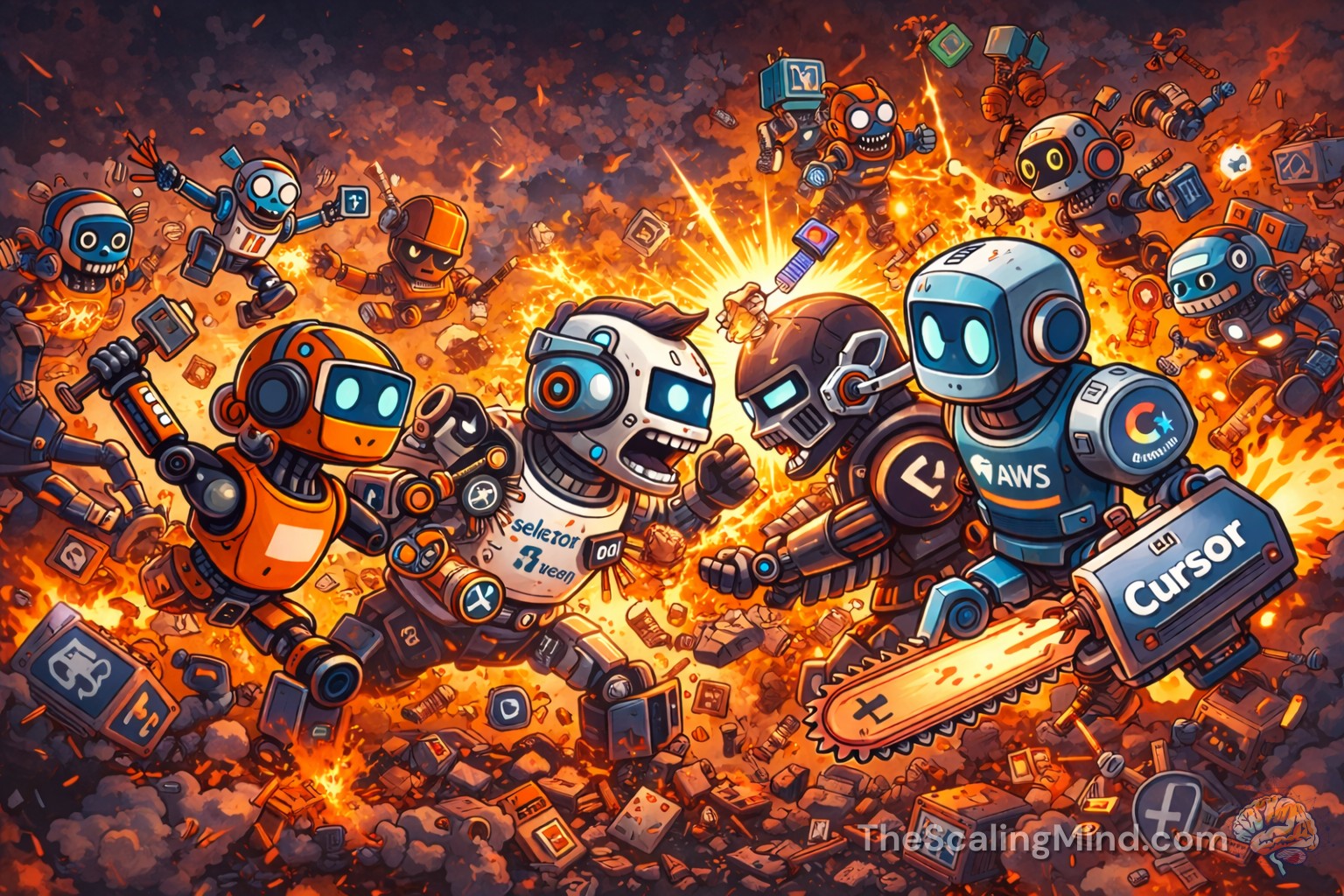
This isn’t just a tool race. It’s a paradigm war about how software will be built from now on.
Intro
We are witnessing the first real industrial revolution in software development — and it’s not being led by humans alone.
Coding agents are no longer autocomplete toys. They plan, refactor, test, debug, and increasingly make architectural decisions. The result? An explosion of tools claiming to be the future of engineering.
But here’s the truth:
This isn’t just a tool race.
It’s a paradigm war about how software will be built from now on.
1. How many coding agents are out there
There are dozens of purpose-built coding agents and many more agent frameworks. Broad categories you’ll see in the market:
- IDE-embedded copilot/agent products (Cursor, GitHub Copilot/Agent Mode, Windsurf/Cascade, Replit/ Ghostwriter-style) — these live inside editors and are optimized for in-context, developer-guided workflows. Cursor and Copilot expose “Agent” features that can take on multi-step tasks.
- Agentic IDEs / platform-first agents (AWS Kiro, Windsurf’s agentic flows) — these aim to manage project-level workflows (spec-driven dev, long-running agentic execution, deploy-to-prod). Amazon’s “Kiro” is explicitly positioned as an agentic IDE to bridge prototype→production.
- Standalone code agents / bots (DevStral, Junie, Junie-like tools, Cline, Solver, etc.) — these run as services or CLI tools that operate on repos, CI, and infra. Infoworld and other surveys list dozens of this class.
- Frameworks & OSS agent toolkits (LangChain-style agent frameworks, Auto-GPT, GPT-Engineer-like repos, and curated “awesome” lists) — these are for building custom agents and glueing models + tools. The community maintains large curated lists.
Bottom line: dozens of shipped products and many more experimental OSS projects — the market is crowded but functionally clustered around “in-IDE copilots”, “agentic IDE/platforms”, “repo-level agents”, and “build-your-own frameworks.”
2. Closed vs open-source and adoption
Closed / Commercial:
Large players/enterprises: GitHub Copilot / Copilot Agent (Microsoft), OpenAI Codex derivatives, Anthropic’s Claude Code, Cursor (commercial), Windsurf (product and now acquiring/transitioning companies), and AWS Kiro (AWS product). These have the strongest enterprise adoption and integration stories. Cursor, Windsurf, and Copilot are widely used in engineering teams. Stack Overflow / developer surveys still show ChatGPT and Copilot as dominant entry points for developers.
Open-source / community:
Many OSS agent frameworks and experimental coding agents exist; the “awesome” agent list and GitHub repos document hundreds of projects (Auto-GPT variants, agent frameworks, repo-based engineer bots). These are great for experimentation, private control, and niche workflows — but less integrated, less polished, and often lacking enterprise-grade security/observability.
Adoption picture:
Enterprise adoption skews to commercial, integrated products (Copilot, Cursor, Claude Code in some adopters, Windsurf earlier). OSS is used for POCs and bespoke pipelines. The most adopted mainstream entry points remain Copilot and ChatGPT-style interfaces per surveys.
With this picture in mind, let’s dive down into what actually differentiates coding agents beyond their underlying models.
This project highlighted the importance of close collaboration and user-centered design. By combining modern development tools with strategic thinking, we delivered a site that’s not only beautiful but built to grow with the client’s business.
3. Valuable differences between Coding Agents
This is where most vendors spin marketing — the substantive differences that determine production value are:
- Context management and memory
- Can the agent hold long repo context, cross-file reasoning, and multi-hour state? This is the first-order product differentiator for real engineering work (not single-function completions).
- Tooling / integration surface
- Native Git/CI integration, terminal access, test runners, build pipelines, cloud deploy hooks. Kiro, for example, emphasizes “spec-driven development” and native tool integration for production readiness.
- Steering, constraints, and policy controls (governance)
- Ability to enforce coding standards, security policies, allowed libraries, and provable constraints (MCP/steering files in Kiro is an example). Without steering, agents are dangerous at scale.
- Verification, test-first pipelines, and CI safety nets
- Agents that produce code but also auto-generate tests, linting, and DRIs for human review produce far more reliable outcomes. The difference between “vibe coding” and production code is this test-and-verify loop.
- Observability and audit trails
- For compliance and debugging you need reproducible plans, action logs, and artifact provenance. Agents without this are not enterprise-deployable.
- Human-in-the-loop UX
- How gracefully can humans intervene, correct, or reject decisions? “Interactive Copilot” vs “autonomous agent” is a major UX difference (and product design choice). Cursor’s Agent vs Tab features illustrate these diverging UXs.
- Security & data residency
- Whether the agent processes your private repo on-prem, in a VPC, or in a public cloud matters fundamentally.
- Operational models & cost controls
- Token usage, billing model for long-running agents, and ability to throttle/limit production runs (Opus 4.5 introduced parameters to trade “effort” vs cost).
Translation: the product-level capabilities (context, integration, verification, governance, observability) matter far more for production than the headline “model name” alone.
4. How important is model choice ?
Short answer: important, but not decisive beyond a quality threshold.
A top model with poor integration will produce worse outcomes thana good model inside a well-engineered agent platform.
My opinion is based on this reasoning:
- At the high end, leading models (Anthropic’s Opus/Claude, OpenAI’s Codex/GPT-5 variants, Google’s Gemini lineage) are within a narrow band for many tasks — they all generate competent code for common patterns. Several benchmarking posts show improvements but diminishing returns as you climb.
- The marginal gains of a new “best” model manifest in hard tasks: large refactors, multi-file reasoning, API migrations, and low-bug-change tasks. If you’re automating small CRUD features, model differences are marginal. If you’re asking an agent to redesign an auth flow across a repo, model quality suddenly matters a lot.
- However — model + product = results. A top model with poor integration (no CI, no tests, no governance) will produce worse outcomes than a good model inside a well-engineered agent platform that enforces tests and deploy rules (this is Kiro’s sales pitch and where enterprise value comes).
- Finally, cost, latency, and offline or private options (fine-tuned LLM running in VPC vs hosted API) are decisive in enterprise usage.
Rule of thumb: pick a model that’s “within the top 10%” for code tasks, then invest the bulk of effort in integration, verification, and governance.
5. How to choose the right coding agent for you (and your org)
There’s no a unique criteria for choosing the right one. If you’re evaluating products/agents, run a scoring rubric with these buckets (weight them to your org):
- Repo context + reasoning (30%) — multi-file diffs, refactor quality, long-horizon plans.
- Tooling & CI integration (20%) — can it run tests, open PRs, roll back, annotate failures?
- Verification & safety (15%) — auto-tests, fuzzing, security checks.
- Governance & steering (10%) — policy files, allowed libs, blacklists. (Kiro’s steering/MCP approach is an example.)
- Observability & audit trails (10%) — action logs, reproducible runs.
- Model & cost (10%) — accuracy on SWEBench/HumanEval-like tasks, token cost and latency.
- Deployment model & data residency (5%) — VPC, on-prem, private model options.
POC methodology (30–60 days):
- One real micro-project (a real bugfix + small feature + refactor).
- Run three approaches: (a) human-only baseline, (b) agent-assisted (human in loop), (c) autonomous agent with strict verification + human approval.
- Measure: time to PR, defects in QA, rollback frequency, human review time, merge-to-deploy time, and ownership burden afterwards.
Finally, let me provide you with some tactical recommendations if you’re an executive leader influencing the AI coding tool adoption strategy:
- Don’t buy “model-only.” Invest in agent platforms that give you steering, CI integration, and reproducibility. Look beyond demos and ask for a full repo trial.
- Start small, guard with tests. Auto-generate tests must be first-class. If an agent can’t produce test coverage that validates its work, it isn’t ready for production.
- Protect the critical paths. Use agents for non-critical code first (internal tools, scaffolding, tests, docs) then expand.
- Enforce policies by design. Use steering/constraint files (policy-as-code) so the agent cannot use forbidden libs or insecure patterns. Kiro’s MCP/steering concept is a good example.
- Measure maintenance cost, not just throughput. Vibe-code velocity without long-term reliability metrics is a debt generator.
- Keep senior engineers as gatekeepers. When agents accelerate production, senior architects become the scarce multiplier: invest in their time for specification, review, and system design.
Final Thoughts
So, the 5 things you must understand about the War of Coding Agents are:
1️⃣ The model matters — but the system matters more
Raw model intelligence is only part of the equation. Context management, tooling integration, testing loops, and guardrails often determine real-world results.
2️⃣ Speed without verification is a debt factory
Agents can 10× output — and 10× bugs, security holes, and architectural drift. Without automated tests and constraints, velocity becomes long-term drag.
3️⃣ Senior engineers are becoming force multipliers, not obsolete
Agents don’t remove the need for experience — they amplify the impact of those who understand systems, trade-offs, and failure modes.
4️⃣ Tool choice is less important than workflow design
The winning teams won’t be the ones with the “best AI,” but the ones who design tight human–agent feedback loops, review systems, and safe deployment pipelines.
5️⃣ This shift changes org design, not just developer productivity
When code becomes cheap, judgment becomes the bottleneck. Architecture, platform engineering, and technical leadership become the new leverage points.
In the end, this isn’t about which agent wins.
It’s about which teams learn to fight the right battles —
and which ones let automation scale their chaos.
Leave a Reply